The 5-Part Marketing Engine Every Growing Company Needs
June 12, 2026
Why Your CRM Is a Mess (And How Marketing Ops Fixes It)
June 12, 2026
How to Build a Content Calendar That Actually Gets Executed
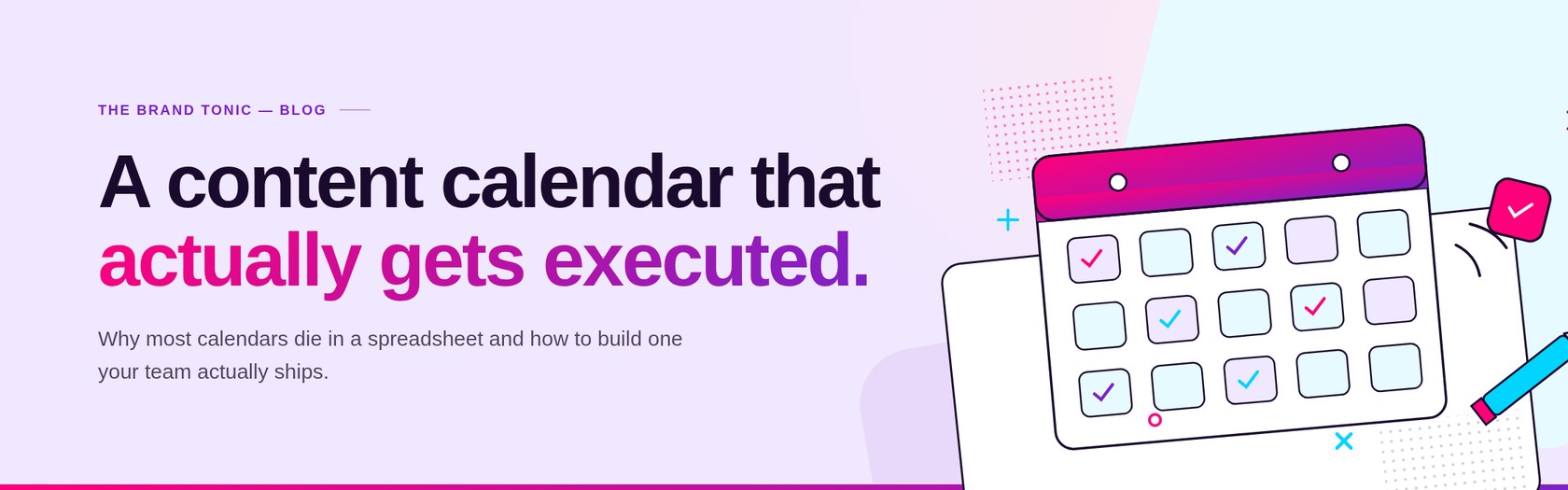
A content calendar isn’t a planning problem. It is an execution problem. Here is how to build one that survives contact with a busy month.
Almost every company has built a content calendar. Most of those calendars are dead. They launch in a burst of January energy, hold for three weeks, then quietly fall apart the first time a real deadline or a sick day collides with “post Thursday.” By March the calendar is a graveyard of good intentions in a spreadsheet nobody opens.
The problem is not your discipline and it is not the tool. A content calendar that dies is not a planning failure, it is a system failure. A calendar is just a schedule; execution requires a system around it. This guide shows how to build a content calendar your lean team will actually run, the kind that survives a busy month instead of dying in one.
The short answer
A content calendar gets executed when it is backed by a system, not just a schedule. That means planning around a sustainable cadence you can actually keep, batching the work so production does not depend on daily willpower, using templates so nothing starts from a blank page, and assigning clear ownership so every item has a name attached. The calendar is the visible 10 percent. The system underneath is the 90 percent that determines whether anything ships.
Why content calendars die
They die for predictable, fixable reasons.
- They are too ambitious. A calendar built for an imaginary team you do not have, five posts a week, three channels, a podcast, collapses the moment real work intrudes. Ambition on the calendar becomes failure in reality.
- They plan the what but not the how. “Publish blog post” sits on Thursday with no plan for when it gets written, by whom, or from what. The calendar assumes execution will just happen. It will not.
- They have no owner. When everyone is responsible, no one is. Items with no name attached are items that slip.
- They rely on willpower. A calendar that requires someone to feel motivated every single day is a calendar that breaks the first hard week. Systems beat willpower, always.
Fix those four and the calendar stops being a wish.
How to build a calendar that survives
Step 1: Set a cadence you can sustain on your worst week, not your best
This is the most important and most ignored step. Plan your cadence for a realistic bad week, not an inspired good one. One excellent post a week that ships every week beats four planned posts that ship sporadically. Under-commit on the calendar and over-deliver in reality. A sustainable cadence you actually hit builds more authority than an ambitious one you abandon.
Step 2: Batch the work, do not improvise it daily
Daily improvisation is what kills lean-team content. Instead, batch. Set aside focused time to plan a month of topics at once, then time to produce several pieces in one sitting. Batching removes the daily decision of “what do I make today,” which is the friction point where calendars die. Produce ahead of schedule so a busy week draws down a buffer instead of breaking the streak.
Step 3: Build from templates, never a blank page
A blank page is where motivation goes to die. Create templates for your recurring formats: a blog structure, a LinkedIn post frame, an email layout. When the calendar says “Thursday blog post,” the writer opens a template with the structure already in place, not an empty document. Templates turn a creative act into a repeatable one, which is exactly what sustainability requires.
Step 4: Assign one owner per item
Every item on the calendar gets a single name attached, the person accountable for it shipping. Not a team, a person. Shared ownership is how things fall through the cracks. Clear ownership is how they get done, and it is how you know who to talk to when something is at risk.
Step 5: Attach distribution to every piece
Publishing is not the finish line. For each calendar item, plan where it gets distributed and how it gets repurposed, before it ships. One blog post should become a week of LinkedIn posts and an email. Building distribution into the calendar is what turns content production into actual reach, and it is what makes the effort worth sustaining.
What this looks like in practice
A lean B2B team had rebuilt their content calendar three times in a year. Each version was more ambitious than the last, and each died faster. They were convinced they needed to hire a content person.
They did not. We cut the cadence to one blog and three LinkedIn posts a week, all derived from the blog. We set a monthly batch session for planning and a weekly one for production, built three templates, assigned every item a single owner, and attached a repurposing plan to each post. Nine months later that calendar was still running, with the same team, through busy quarters and vacations. The difference was never ambition or talent. It was a system the calendar could lean on.
Frequently asked questions
Why does my content calendar keep falling apart? Almost always because it is too ambitious and has no system underneath it. A calendar is a schedule; it does not execute itself. If your cadence assumes a team you do not have, or it plans the what without the how, it will break the first busy week. Cut the cadence and build the batching, templates, and ownership around it.
How often should a small business publish content? Less often than you think, and more consistently. A single high-quality piece per week that ships reliably outperforms an ambitious schedule you cannot sustain. Pick the cadence you can keep on a bad week, then hold it. Consistency compounds; sporadic bursts do not.
What is the difference between a content calendar and a content system? A content calendar is the schedule of what publishes when. A content system is everything that makes the schedule happen: the cadence, batching, templates, ownership, and distribution. The calendar is visible; the system is what determines whether anything on it actually ships.
Should I batch content or create it as I go? Batch it. Creating content as you go relies on daily motivation and gets crowded out by other work. Batching, planning topics monthly and producing several pieces in focused sessions, removes the daily decision and builds a buffer that protects you during busy weeks.
The bottom line
A content calendar that gets executed is not a better spreadsheet, it is a calendar backed by a system: a sustainable cadence, batched production, templates instead of blank pages, clear ownership, and distribution built in. Plan for your worst week, not your best, and build the structure that ships the work whether or not anyone feels inspired.
If your content keeps stalling, the fix is a system, not more discipline. See how we build content systems that actually run at The Brand Tonic’s Content Marketing Strategy, or book a call to build one your team will keep.