Your Marketing Isn’t Failing. Your System Is.
June 12, 2026
How to Build a Content Calendar That Actually Gets Executed
June 12, 2026
The 5-Part Marketing Engine Every Growing Company Needs
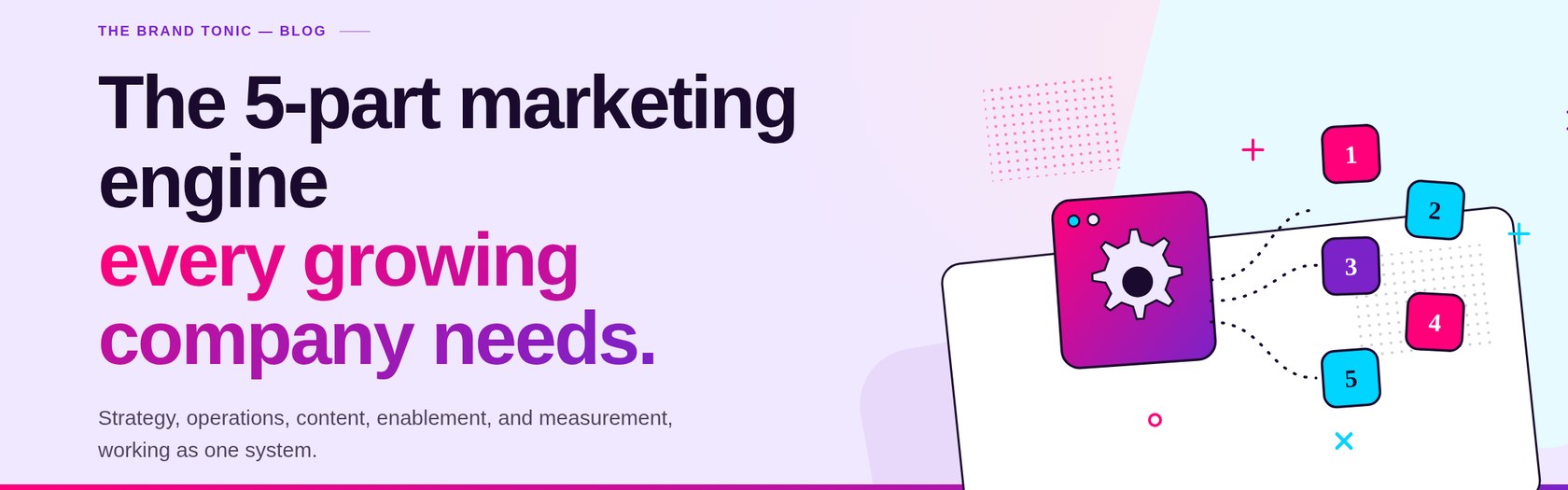
A marketing engine isn’t a channel or a campaign. It is five connected parts working together. Here is the framework.
“We help growing companies build a marketing engine.” It is a phrase worth defining, because most companies that say they want one are actually asking for a part of it: more leads, better content, a working CRM. Those are components. An engine is what happens when the components are connected and running together.
A marketing engine is a system where five parts, strategy, operations, content, demand, and measurement, work as one connected machine instead of five disconnected efforts. When they are linked, marketing compounds: each part makes the others more effective. When they are not, you get the familiar growing-company problem, busy marketing that does not add up. This is the framework, part by part, and how to build it without a full department.
The short answer
A marketing engine has five parts: strategy (the direction), operations (the system that runs it), content (the fuel), demand (how you reach and capture buyers), and measurement (the feedback loop). The engine works only when all five are connected. Most growing companies have two or three running in isolation, which is why their marketing feels busy but flat. Building the engine means installing the missing parts and connecting all of them to one goal.
Why a “marketing engine,” not a list of tactics
The engine metaphor is doing real work. A car engine is not a pile of parts; it is parts arranged so motion in one creates motion in the others. Marketing is the same. A great piece of content is wasted without distribution. Distribution is wasted without a strategy aiming it. Strategy is theoretical without operations to execute it. And none of it improves without measurement.
This is why buying tactics one at a time rarely works. You can have good content and still get nothing if it is not connected to demand and measurement. The engine framework forces you to build the connections, not just the components.
The five parts of the engine
Part 1: Strategy (the direction)
Strategy is the engine’s steering. It defines the goal marketing owns, the best-fit customer, the core message, and the roadmap. Without it, every other part runs hard in random directions. Strategy is what makes the rest of the engine point at the same outcome, and it is the part most lean teams skip in their rush to do.
Part 2: Operations (the system that runs it)
Operations is the engine block, the structure everything else mounts to. It is the workflows, the tech stack, the CRM, the automation, and the documentation that let marketing run consistently without heroics. Operations is invisible when it works and catastrophic when it is missing, because without it even a great strategy cannot be executed reliably.
Part 3: Content (the fuel)
Content is what feeds the engine: the articles, emails, sales assets, and social posts that carry your message to your market. But content only produces energy when it is connected to strategy (so it says the right thing) and operations (so it ships consistently). Content disconnected from the other parts is the most common form of wasted marketing spend at growing companies.
Part 4: Demand (reach and capture)
Demand is how the engine actually moves people: the channels and mechanisms that get your content in front of the right buyers and capture their interest. This is distribution, SEO, email, social, and the website doing its job of turning attention into leads. Demand is where a lot of companies start, which is backwards, because reach without strategy and content behind it just amplifies a weak message.
Part 5: Measurement (the feedback loop)
Measurement is the engine’s instrumentation. It tells you which parts are producing, which are stalling, and where to put effort next. Without it, you are driving blind, unable to say what is working or to improve. With it, the whole engine gets smarter every cycle, because you stop guessing and start adjusting based on what the numbers show.
How the parts connect
The framework’s real lesson is the connections, not the parts:
- Strategy tells content what to say and demand who to reach
- Operations lets content and demand run consistently
- Content gives demand something worth distributing
- Demand turns content into reach and leads
- Measurement feeds learning back into strategy, closing the loop
When all five connect, you get compounding: better measurement sharpens strategy,sharper strategy improves content, better content lifts demand, and operations makes all of it repeatable. That compounding is the entire reason to build an engine instead of buying tactics.
What this looks like in practice
A growing healthtech company had three of the five parts: decent content, active demand channels, and a CRM. What they lacked was strategy connecting them and measurement closing the loop. So they produced content with no clear message, ran channels with no clear goal, and could not say what was working.
We did not add more content or more channels. We installed the two missing parts and connected all five: a strategy that pointed everything at qualified pipeline, and a measurement system that showed what produced it. Within two quarters, the same content and channels, now aimed and instrumented, were generating a predictable flow of qualified leads. The components had been there all along. They just were not an engine yet.
How to build your engine without a full department
You do not need a large team to build this. You need the parts connected and someone owning the whole.
- Audit which parts you have. Most companies have content and demand, and are missing strategy, operations, or measurement.
- Install the missing parts, starting with strategy if it is absent, because nothing else aims correctly without it.
- Connect everything to one goal so the parts reinforce instead of compete.
- Add measurement so the engine can improve itself.
- Give it an owner. An engine with no one accountable for the whole drifts back into disconnected parts. This is exactly what a fractional marketing leader provides: ownership of the entire engine, not just one part.
Frequently asked questions
What is a marketing engine? A marketing engine is a connected system of five parts, strategy, operations, content, demand, and measurement, working together so marketing produces compounding, repeatable results instead of one-off campaigns. The defining feature is that the parts are linked and aimed at one goal, not run in isolation.
How is a marketing engine different from a marketing strategy? Strategy is one part of the engine, the direction. The engine is the full system that turns that direction into consistent execution and measurable results. You can have a strategy and still lack an engine if operations, content, demand, and measurement are not built and connected.
Do I need a big team to build a marketing engine? No. The engine is about connection and ownership, not headcount. A lean team, or a fractional marketing leader paired with operations support, can build and run all five parts. The size of the engine scales with you; the structure matters more than the staff.
Which part of the marketing engine should I build first? Strategy, if you do not have it, because every other part depends on it for direction. If strategy exists but results are still flat, the missing part is usually measurement or operations. Audit honestly, then install the part whose absence is doing the most damage.
The bottom line
A marketing engine is not a channel, a campaign, or a single hire. It is five connected parts, strategy, operations, content, demand, and measurement, working as one system so your marketing compounds instead of resetting. Most growing companies have a few parts running in isolation. The work is installing what is missing and connecting all of it to one goal, with someone owning the whole.
That ownership of the full engine is what we do. See how at The Brand Tonic’s Fractional CMO Services, or book a call and we will map which parts of your engine are missing.