Healthcare Marketing Strategy: A System for Healthtech and Provider Companies
July 7, 2026
The Marketing Tech Stack a 5-100 Person Company Actually Needs
July 7, 2026
SaaS Marketing Strategy: How Startups Build One That Compounds
Most SaaS marketing advice has a hidden assumption baked into it: that you have a marketing team. The playbooks were written by companies with ten marketers, a paid media budget, and a RevOps function. Then a 20-person startup runs the same play with a founder, a product manager moonlighting as a marketer, and a freelancer. It fails, and everyone concludes marketing does not work.
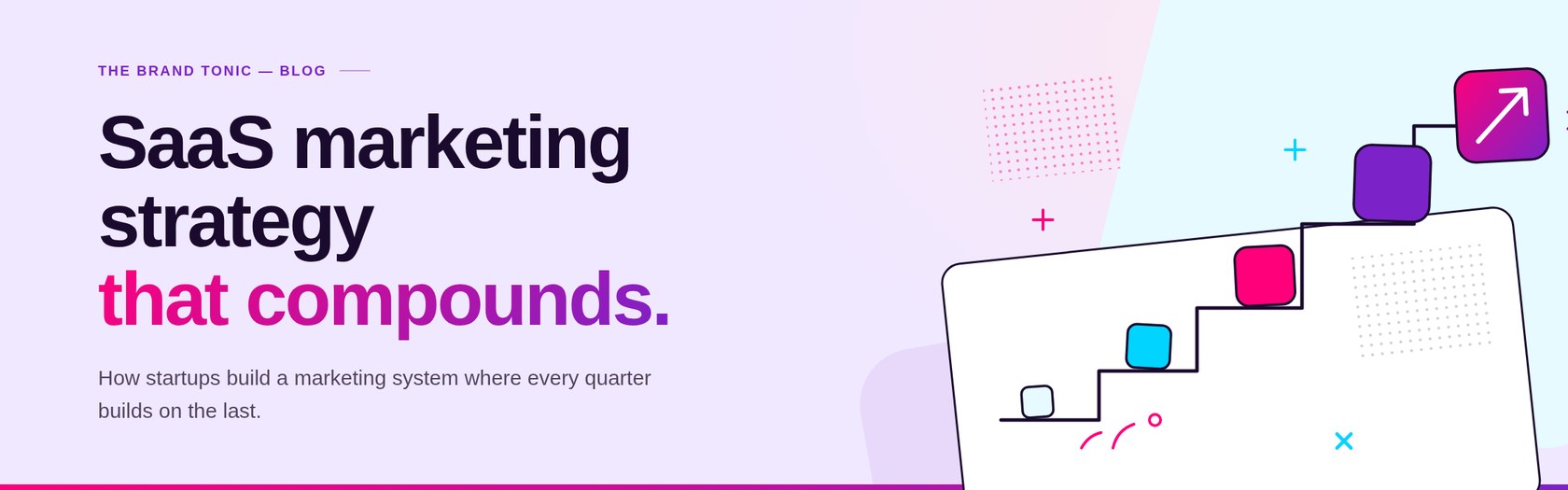
Marketing works fine. The strategy was built for a company you are not yet. A real SaaS marketing strategy at the startup stage looks different: fewer channels, tighter sequencing, and a bias toward things that compound rather than spike. Here is how to build one, in the right order, with the team you actually have.
The short answer
A SaaS marketing strategy for a startup is a sequenced plan, not a channel list. Nail positioning first, then build one acquisition channel into a repeatable system, then add lifecycle and email to convert and retain, then layer in measurement so you know what to scale. Startups fail at marketing when they skip the sequence and try to run five channels at once with no owner.
Why most SaaS marketing advice fails early-stage teams
Search “b2b saas marketing” and the results are overwhelmingly produced by late-stage companies and the vendors who sell to them. That advice assumes:
- Headcount you do not have. ABM needs SDR coordination, intent data, and dedicated ops. A content engine assumes writers, an editor, and a distribution owner.
- Budget you should not spend. Paid acquisition benchmarks come from companies with proven unit economics. Spending $30K a month to learn your CAC is a late-stage luxury.
- Positioning you have not earned. Enterprise playbooks lean on brand recognition and analyst coverage. You have neither, which changes which channels can work.
Annual SaaS benchmark surveys from firms like OpenView and SaaS Capital show the same thing every year: sub-$5M ARR companies operate under completely different constraints than the companies writing the playbooks. Copying upmarket tactics downmarket is the most common strategic error we see.
For the broader framework of operating without internal marketing leadership, see how to run a GTM strategy without a head of marketing.
What makes a channel compound?
This is the principle that should govern every channel decision at this stage.
A compounding channel gets cheaper or more effective the longer you run it. SEO builds an asset base that keeps producing traffic. A referral loop grows with your customer base. Compare that to paid ads, which stop producing the moment you stop paying, or cold outbound, which resets to zero every Monday.
Non-compounding channels are useful for speed and message testing. But a startup with limited budget should anchor on at least one compounding channel early, because that is the only way a small team outruns better-funded competitors.
How do you build a SaaS marketing strategy in the right order?
The sequence matters more than the tactics. Here it is.
Step 1: Positioning before everything
Before a single campaign, you need clear answers to four questions: who is this for, what problem does it solve, what category does the buyer put you in, and why you over the alternative they already use. Weak positioning makes every downstream channel more expensive because your ads, pages, and emails all have to work harder to explain you.
Deliverable: a one-page positioning doc the whole company agrees on. Not a brand book. One page.
Step 2: One acquisition channel, built as a system
Pick one channel based on where your buyers already look for solutions, and build it as a system with an owner, a cadence, and a quality bar. One channel done as a system beats four channels done as experiments.
- If buyers search for the problem, that channel is probably SEO plus bottom-of-funnel content.
- If buyers live in communities or on LinkedIn, it is founder-led content and social.
- If your ACV supports it and the market is definable, it is targeted outbound.
Run it for two quarters minimum before judging it. Compounding channels look like failures at week six.
Step 3: Lifecycle and email
Once the top of the funnel produces leads, most startups leak them. Lifecycle marketing is the highest-ROI work at this stage because it converts demand you already paid to create: onboarding sequences, trial nurture, demo follow-up, and win-back. Email is unglamorous and it compounds; every sequence you build keeps working.
Step 4: Measurement that answers real questions
You do not need an attribution platform. You need answers to five questions: where do leads come from, what do they cost, how do they convert to pipeline, how does pipeline convert to revenue, and what is retention doing. A spreadsheet plus clean CRM fields gets you there. Measurable ROI is a habit, not a software purchase.
Does PLG change the strategy?
It changes the emphasis, not the sequence. In a product-led motion the product is the conversion surface, so lifecycle work moves up in priority and your channel feeds signups instead of demos. In a sales-led motion, content and outbound feed a pipeline humans close, so sales enablement matters earlier. Either way, positioning comes first and focus beats sprawl. Most B2B SaaS companies under 100 people end up hybrid, one more reason the strategy needs a single owner rather than a committee.
Common startup mistakes to avoid
- Channel hopping. Trying LinkedIn ads for six weeks, then a podcast, then SEO, then events. Nothing compounds because nothing runs long enough to.
- Hiring junior first. A coordinator without strategic direction produces activity, not pipeline. Strategy has to exist before junior execution can be useful.
- Copying enterprise playbooks. ABM, field marketing, and analyst relations are stage-inappropriate for most sub-50-person companies.
- Confusing motion with progress. Publishing, posting, and sponsoring feel productive. Without a roadmap tied to revenue, it is expensive noise.
- Letting marketing be everyone’s side quest. When no one owns marketing, it becomes pretty PDFs and last-minute launch support.
What this looks like in practice
A 30-person B2B SaaS company came to us post-Series A. They had tried paid ads, a podcast, two freelance writers, and a rebrand in 18 months. Pipeline was flat and the CEO could not say what any of it returned.
We rebuilt the strategy in sequence. First, positioning: interviews with 12 customers revealed buyers saw them as a niche compliance tool, not the workflow platform they pitched, so the messaging shifted to match how buyers actually searched. Second, one channel: bottom-of-funnel SEO targeting the 40 search terms their buyers used at decision stage, published on a fixed cadence with a real editorial bar. Third, lifecycle: a trial nurture sequence and a demo no-show recovery flow, which lifted trial-to-demo conversion within the first quarter. Measurement was a monthly scorecard the CEO could read in five minutes.
Nine months in, organic pipeline was the top source of qualified demos, and the cost per opportunity was a fraction of what paid had produced. Nothing exotic. Sequence, focus, and an owner.
What should a startup strategy doc actually contain?
Not a 60-slide deck. At this stage a working strategy doc needs six things:
- Positioning: ICP, problem, category, differentiation (one page)
- The one or two channels you are committing to, and why
- The lifecycle map: what happens after someone converts
- A 90-day roadmap with owners and deadlines
- The five metrics you will review monthly
- What you are explicitly not doing this year
That last section is the most valuable one. Strategy is mostly the discipline of saying no.
Frequently asked questions
How much should a SaaS startup spend on marketing? Spend is the wrong first question. Decide strategy and channel focus first, then fund the smallest version that can prove or disprove it. Most early-stage teams get further with $8K to $20K a month against one system than $50K sprayed across five channels.
When should a SaaS startup hire its first marketer? When there is a documented strategy for that person to execute. If you hire before strategy exists, hire senior or bring in fractional marketing leadership to set direction first. A junior hire into a strategy vacuum burns 6 to 12 months.
What is the best marketing channel for B2B SaaS? The one your buyers already use when they look for solutions, run long enough to compound. For most B2B SaaS that is search-driven content or founder-led social, with outbound as an accelerant when ACV supports it.
How long before a SaaS marketing strategy shows results? Lifecycle and conversion fixes show results in weeks. Compounding acquisition channels typically need two to three quarters to produce meaningful pipeline. Set expectations by channel type up front so no one kills a working system at week eight.
Is PLG or sales-led better for an early-stage SaaS company? Neither is better in the abstract. Low ACV and self-serve-friendly products favor PLG; complex products with six-figure deals favor sales-led. The strategy sequence in this post applies to both, and most companies end up running a hybrid.
The bottom line
A SaaS marketing strategy that works at the startup stage is narrow, sequenced, and owned. Positioning first. One channel built as a system. Lifecycle to convert the demand you create. Measurement that answers real questions. That is how a small team builds a marketing engine that compounds instead of expensive experiments that reset to zero.
If you want a strategy built for your stage, your budget, and your team, that is exactly what our marketing strategy consulting engagement delivers. Book a call and we will show you what the first 90 days would look like.