Brand Positioning Strategy: How to Claim a Category Buyers Remember
September 22, 2026
B2B SEO Strategy: How Lean Teams Rank Without a Content Mill
September 29, 2026
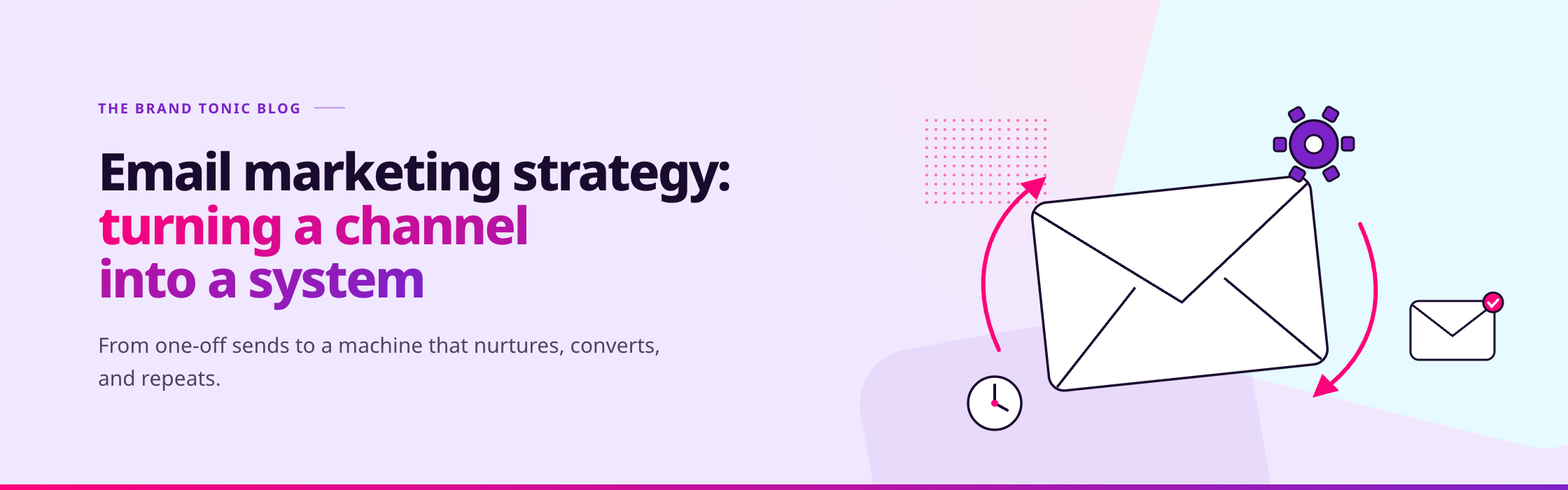
Most companies treat email like a chore they get to when there’s time: a newsletter here, a product announcement there, a discount blast when the pipeline looks thin. That’s not an email marketing strategy. It’s a series of one-off sends competing for the same inbox real estate with no plan behind any of them. Email, done right, is one of the most reliable channels you have, because unlike social algorithms or paid ad costs, you own the list and the relationship. But that reliability only shows up when email operates as a system, not a task. This post covers how to turn email from a channel you remember to use into a system that runs consistently, what the core lifecycle stages actually are, and how it ties into the rest of your marketing operations.
The short answer
An email marketing strategy is a structured system of lifecycle-based email sequences, triggered by where a contact is in their relationship with you, rather than a calendar of one-off campaigns. It includes a welcome sequence, ongoing nurture content, and a re-engagement path for contacts who’ve gone quiet, all connected to your CRM so the right message reaches the right person automatically. Done as a system, email becomes a channel that compounds. Done as isolated sends, it stays a task nobody prioritizes consistently.
Why do one-off email blasts fail as a strategy?
Because they depend entirely on someone remembering to send them, and they treat every contact the same regardless of where that contact actually is in their journey with you. A brand-new subscriber and a customer who’s been with you three years get the same newsletter. A lead who downloaded a resource yesterday and one who’s been sitting cold for six months get the same promotional email. None of it is personalized to intent or stage, so performance stays mediocre no matter how good the copy is.
According to research from Litmus, email consistently ranks among the highest-ROI marketing channels available, but that return depends heavily on relevance and segmentation, not just send volume. A system built around lifecycle stage is what makes that relevance possible at scale, without a person manually deciding what to send each contact every day.
What are the core lifecycle stages an email system should cover?
- Welcome. The sequence a new subscriber or lead gets immediately after opt-in. This is your highest-attention window, when someone is most curious about you, and it should introduce who you are, set expectations, and guide them toward a next step, not just say thanks for subscribing.
- Nurture. Ongoing value-driven content for contacts who aren’t ready to buy yet. This is where you build trust over time, sharing insights, addressing objections, and staying present without constantly pitching.
- Conversion. Triggered sends aimed at contacts showing buying signals, a pricing page visit, a demo request, repeated engagement with specific content. These are more direct and time-sensitive than general nurture content.
- Retention. Emails for existing customers focused on onboarding, adoption, and expansion, not just new-customer acquisition. Retention email is often underbuilt, even though it protects revenue you’ve already earned.
- Re-engagement. A sequence for contacts who’ve gone quiet, opened nothing, clicked nothing, for an extended period. The goal is either to win back attention or to clean the list, both of which protect your sender reputation and your data quality.
How does email marketing strategy connect to marketing operations?
Email can’t function as a system in a vacuum. It needs to be tied to your CRM, so triggers fire based on real contact behavior and data, not guesswork. A contact who fills out a form should automatically enter the right sequence based on what they filled out. A contact who becomes a customer should automatically exit the nurture track and enter onboarding. None of that happens reliably without clean CRM data and defined operational rules connecting your email platform to the rest of your systems.
This is exactly where marketing operations does the unglamorous but essential work: making sure your CRM fields, list segments, and automation triggers are actually built correctly, so the strategy you designed on paper functions the same way in production. A brilliant lifecycle strategy built on messy CRM data will misfire constantly, sending the wrong message to the wrong person at the wrong time, which erodes trust in the channel faster than sending nothing at all.
What this looks like in practice
A 50-person SaaS company had an email list of around 12,000 contacts and sent, on average, one newsletter a month, whenever the team had bandwidth. Open rates were mediocre, unsubscribes crept up steadily, and the sales team routinely complained that marketing-sourced leads went cold before anyone followed up.
The fix started with mapping their actual contact lifecycle: what happened the moment someone opted in, what happened after a demo request, what happened to a lead who went quiet for 60 days. None of those moments had a defined email response. Building a welcome sequence alone, four emails over two weeks introducing the product, sharing a customer story, and prompting a next step, immediately outperformed the monthly newsletter’s engagement rates, because it was relevant to exactly where that contact was.
From there, a simple nurture track for non-sales-ready leads and a re-engagement sequence for 90-day-quiet contacts rounded out the system. None of this required new headcount. It required treating email as an operational system tied to CRM triggers rather than a monthly task on someone’s calendar. Within two quarters, email-attributed pipeline became a metric the team could actually track and trust, instead of a vague sense that “we send newsletters.”
This same systems thinking is what makes content marketing strategy and email reinforce each other rather than compete for the same content: blog and resource content feeds the nurture sequences, and email becomes the distribution engine that gets that content in front of the right contact at the right moment.
How do you know if your email program is a system or just a habit?
- Does a new contact automatically receive a defined sequence, or does it depend on someone remembering to add them?
- Are sends triggered by contact behavior and CRM data, or purely by the calendar?
- Can you report on which lifecycle stage is underperforming, or only on whether the last blast got opened?
- Does a contact’s email experience change once they become a customer, or do they keep getting the same content as a brand-new lead?
If most of your answers point to manual, calendar-driven, undifferentiated sending, you have a habit, not a system.
Frequently asked questions
How often should you send marketing emails? There’s no universal number. It depends on lifecycle stage and content value, not a fixed cadence. Welcome sequences move faster (days), nurture content is more spaced out (weekly or biweekly), and re-engagement sends are infrequent by design. Consistency within each track matters more than overall frequency.
What’s the difference between email marketing and email automation? Email marketing is the broader discipline. Automation is the mechanism that makes lifecycle-based email possible at scale, using CRM or platform triggers instead of manually sending each message.
Do small companies need a CRM to run a real email strategy? Not a complex one, but you need something that tracks contact behavior and stage well enough to trigger the right sequence. Without that, personalization at scale isn’t realistic.
How do you measure whether an email strategy is working? Look past open and click rates to lifecycle-stage metrics: how many welcome-sequence contacts convert to a next step, how much pipeline nurture sequences influence, how many re-engaged contacts return to active status.
Is email marketing still effective, or has it been replaced by social and paid channels? Email remains one of the highest-ROI channels available because you own the list and aren’t subject to algorithm or ad-cost volatility. Its effectiveness depends on running it as a relevant, segmented system rather than one-size-fits-all blasts.
The bottom line
Email marketing strategy stops being a chore the moment it becomes a system tied to your contact lifecycle and your CRM, instead of a monthly task someone remembers to do. If your email program is still a handful of one-off blasts, the fix isn’t better subject lines. It’s building the lifecycle structure and the operational plumbing underneath it. Talk to us about building an email system that runs as a real part of your marketing engine.