

Outsourced Marketing vs. Fractional Marketing: Which One Fits?
August 18, 2026
12 Marketing KPIs Every Lean Team Should Actually Track
August 25, 2026
Somewhere in the last few years, “marketing automation” turned into a synonym for “buy this software and your problems go away.” It is not. Marketing automation for small business only works when it sits on top of a process that already makes sense. Automate a broken workflow and you do not fix it, you just break it faster and at a bigger scale.
That is the trap a lot of growing companies fall into. They buy a tool, connect it to their CRM, build a few email sequences, and wait for leads to convert themselves. Then three months later nothing has changed except now there is an automation platform nobody fully understands sitting on top of the same disorganized process.
This post is a practical guide to what marketing automation for small business should actually look like: what to automate first, what to leave alone until your process is solid, and how to build a system instead of collecting more software.
The short answer
Marketing automation for small business works when it is applied to a process that is already defined, not used to invent one. Start with lead capture, lead routing, and basic nurture sequences, since those have the clearest rules and the highest immediate payoff. Automation should reduce manual work on repeatable tasks, not replace the strategic thinking about who you are targeting and why.
Why does marketing automation fail for so many small businesses?
Most failed automation projects have the same root cause: the process was never clearly mapped out before someone tried to automate it. If your sales team is not sure what counts as a qualified lead, automating lead scoring just automates confusion. If nobody agreed on your follow-up cadence, an automated nurture sequence just sends generic emails into the void.
Automation amplifies whatever is already happening. A clean process becomes faster and more consistent. A messy process becomes messier, faster.
What should you automate first?
Start with the workflows that are repetitive, rule-based, and already well understood by your team. These are the highest-leverage, lowest-risk places to begin.
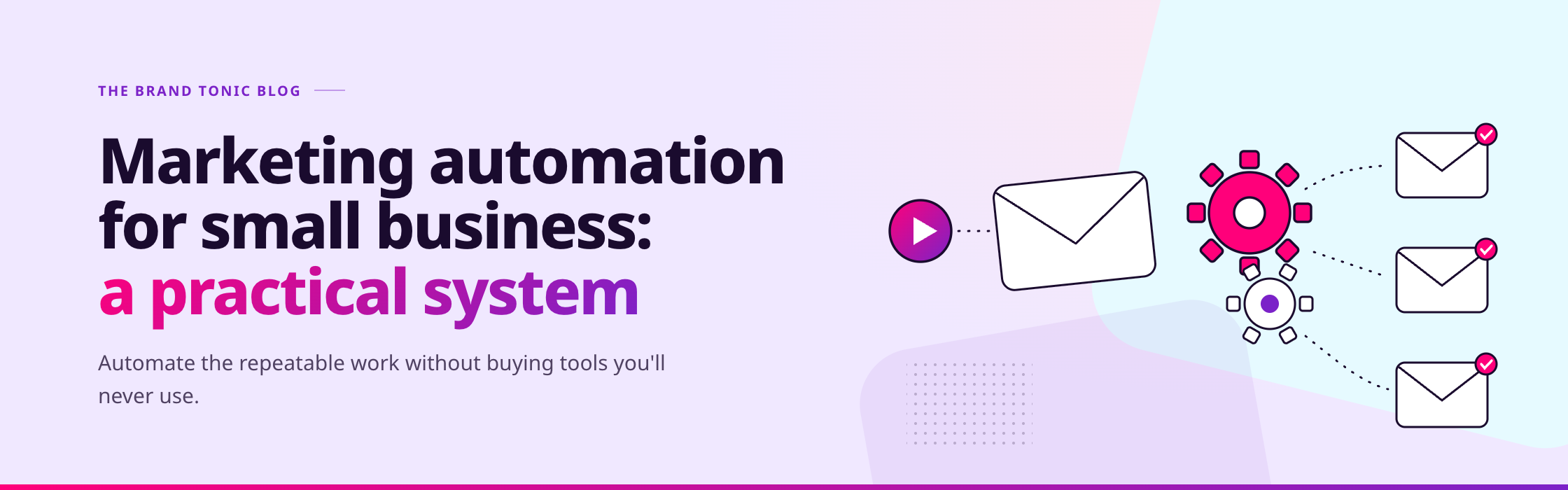
- Lead capture. Every form on your site should feed directly into your CRM with no manual entry. This sounds basic, but a surprising number of small businesses still have leads sitting in a spreadsheet or an inbox that someone checks “when they get a chance.”
- Lead routing. Once a lead comes in, it needs to reach the right person automatically, based on rules you set (deal size, industry, source). Manual routing is where leads go cold.
- Basic nurture sequences. A structured email sequence for new leads who are not yet sales-ready keeps them warm without requiring a person to remember to follow up.
- Reporting and reminders. Automated dashboards and internal reminders (a lead has gone untouched for three days, a deal has stalled) keep your team accountable without someone manually checking spreadsheets every week.
Notice that none of this requires a complicated platform. It requires clear rules first, then a tool that can execute them.
What should you wait to automate?
Anything that still requires judgment calls, or that your team has not agreed on yet, should stay manual until it is defined. That includes:
- Lead scoring criteria you have not tested yet
- Complex, multi-branch nurture journeys before you have proven a simple one works
- Personalized outreach that depends on nuance a rule cannot capture
- Any process only one person understands, since automating it just hides the knowledge gap instead of solving it
According to HubSpot Research, companies that see the strongest ROI from marketing automation tend to implement it in stages, starting with a small number of high-confidence workflows rather than automating their entire funnel at once. That staged approach also gives you room to catch mistakes before they scale.
How does CRM automation fit into this?
Your CRM is the backbone of the whole system. If your CRM data is inconsistent (duplicate contacts, missing fields, unclear stage definitions), automation built on top of it will inherit those problems. CRM automation should focus on:
- Keeping contact and deal records clean automatically (deduping, standardizing fields)
- Triggering internal notifications at key stages (new lead assigned, deal moved to proposal)
- Syncing marketing and sales activity so both teams see the same picture
This is also where a lot of small businesses discover they do not actually have a marketing tech stack. They have a pile of disconnected tools that do not talk to each other. Fixing that connective tissue is often more valuable than any single automation.
What this looks like in practice
A 25-person SaaS company had HubSpot, a separate email tool, and a spreadsheet their sales team used to track “hot” leads. Leads from the website were manually copied into the spreadsheet once a day, sometimes less often. By the time sales followed up, some leads were a week old. Through a marketing operations consulting engagement, the fix was not a new platform. It was consolidating everything into HubSpot, automating lead capture and routing so a new lead triggered an instant Slack notification to the right rep, and building one simple three-email nurture sequence for leads not yet ready to talk. No lead scoring, no branching logic, nothing fancy. Follow-up time dropped from days to hours, and the sales team finally trusted that leads were not falling through the cracks.
What tools do small businesses actually need?
You do not need the most expensive platform on the market. You need a CRM and a marketing automation tool that integrate cleanly with each other and with the rest of your stack (your website, your ad platforms, your reporting). Popular options for small and mid-sized companies include HubSpot, ActiveCampaign, and Mailchimp for the automation layer, paired with whatever CRM your sales team is already comfortable using.
The right tool matters less than whether someone owns the system end to end. Automation without ownership tends to drift: sequences go stale, rules stop matching reality, and nobody notices until pipeline starts slipping.
Frequently asked questions
What is the first thing a small business should automate? Lead capture and routing. These are rule-based, low-risk, and have an immediate, visible payoff: leads reach the right person faster instead of sitting in an inbox.
Do I need a big budget to start with marketing automation? No. Most small business marketing automation tools have affordable entry tiers, and the highest-value early wins (capture, routing, a simple nurture sequence) do not require advanced features.
Can marketing automation replace a marketing team? No. Automation executes repeatable tasks. It does not decide strategy, write compelling content, or interpret what your data means. It is a force multiplier for a marketing function that already has direction, not a replacement for one.
How do I know if my process is ready to automate? If your team can clearly explain the rules (what triggers what, who owns each step, what “done” looks like) without disagreement, it is ready. If people describe the process differently depending on who you ask, fix that first.
What is the biggest mistake companies make with marketing automation? Automating a process before defining it. This usually happens when a company buys a tool first and tries to figure out the strategy afterward, which almost always produces more mess than efficiency.
The bottom line
Marketing automation for small business is not about the tool. It is about the system underneath it. Get your process defined, start with the highest-confidence workflows, and let automation do what it is good at: executing clear rules consistently, at scale. If your marketing tech feels more like a pile of disconnected tools than a working system, talk to The Brand Tonic about building marketing operations that actually hold together.


