7 Signs Your Company Needs Fractional Marketing Leadership
July 7, 2026
Fractional CMO vs. Full-Time CMO: What’s Right for Your Stage?
July 7, 2026
How Much Does a Fractional CMO Cost? Pricing Models Explained
You searched for a number, and most articles gave you a shrug. “It depends” is technically true and completely useless when you are trying to build a budget. So here is the uncomfortable reality: fractional CMO pricing varies wildly because the market lumps three very different things under one title. A consultant who sends you a strategy deck. A senior operator who owns your marketing outcomes. And a freelancer who renamed themselves. All three call themselves fractional CMOs, and they price like three different species. This guide gives you the real numbers, what moves them, and how to tell a price that reflects real leadership from a title someone gave themselves last Tuesday.
The short answer
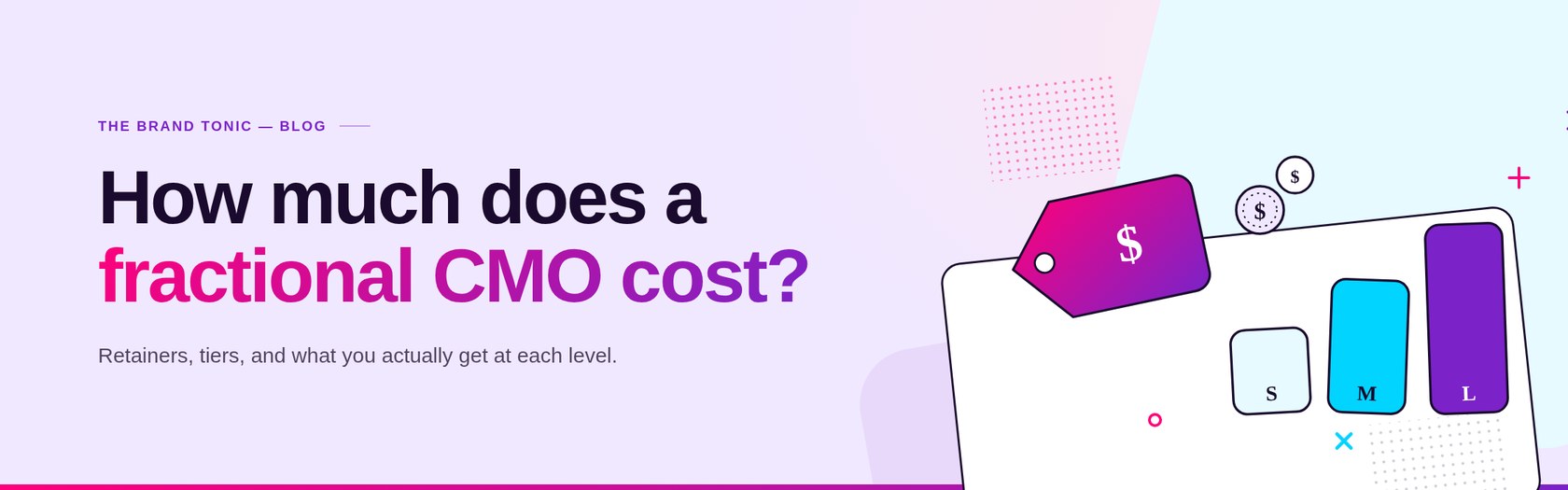
Most fractional CMOs charge a monthly retainer between $3,000 and $20,000+, with the serious-engagement range sitting at $6,000 to $20,000 per month. Below $5,000, you are usually buying advice, not ownership. At $6,000 to $8,000, expect strategy plus light execution support. At $10,000 to $15,000, expect a full fractional CMO who runs your marketing function with operations support behind them. At $15,000 to $20,000, expect deep executive engagement. Compare that to a full-time CMO, where salary data sources consistently put total compensation above $200,000 per year before equity and benefits.
What are the fractional CMO pricing models?
Three models dominate the market. Only one of them consistently works.
Monthly retainer
The standard, and for good reason. You pay a flat monthly fee for a defined scope of leadership and execution. Retainers typically run $3,000 to $20,000+ per month depending on scope and seniority.
Retainers work because they align incentives. Your fractional CMO is paid to move your marketing forward, not to log hours. They can spend a week untangling your attribution model without worrying about how the invoice reads. You get predictable costs, and they get the room to do strategic work that does not fit neatly into billable increments.
Hourly
Hourly rates for fractional CMO work typically run $150 to $400 per hour. It sounds flexible. In practice, it punishes exactly the behavior you want.
Hourly billing turns every strategic conversation into a meter running in the background. It nudges you to ration access to your marketing leader, which is the opposite of what a growing company needs. It also nudges the CMO toward activity that is easy to invoice rather than outcomes that are hard to itemize. If a fractional CMO leads with an hourly rate, they are pricing like a freelancer, and they will probably work like one. We covered why that distinction matters in what fractional marketing leadership actually is.
Equity or hybrid
Some fractional CMOs take reduced cash plus equity, usually with early-stage startups. This can work if the CMO has real skin-in-the-game conviction and the company has a credible path to a liquidity event. For most companies in the 5 to 100 person range, cash retainers keep the relationship clean and the expectations clear.
What drives fractional CMO pricing up or down?
Four factors explain most of the spread in the market.
- Scope. Strategy only is cheaper than strategy plus execution. A CMO who hands you a roadmap costs less than one who builds the marketing engine that runs it.
- Seniority. Thirteen years of leading marketing costs more than three years of managing social media. You are paying for pattern recognition, and pattern recognition compresses time.
- Whether ops execution is included. This is the biggest hidden variable. A solo fractional CMO gives you strategy and then hands the to-do list back to your team. An engagement that includes marketing operations support means the work actually ships. Expect to pay more for it, and expect it to be worth more.
- Time commitment. One strategy call per month is a different product than embedded leadership across your week. More days, more depth, higher retainer.
What should you get at each price level?
- $3,000 to $5,000 per month. Advisory. Monthly or biweekly strategy calls, feedback on your plans, a sounding board. Useful if you already have a strong internal team that just needs direction. Risky if you do not, because advice without execution is a nicely formatted list of things nobody does.
- $6,000 to $8,000 per month. Strategy plus light operations. A real roadmap, prioritization, channel strategy, and hands-on support for the highest-impact items. This is where fractional leadership starts producing measurable ROI for companies without internal marketing leadership.
- $10,000 to $15,000 per month. A full fractional CMO engagement. Someone owns your marketing function, builds the systems, manages the execution, and reports on results with numbers your CFO respects. This is the range where the marketing engine actually gets built.
- $15,000 to $20,000+ per month. Deep executive engagement. Board-level reporting, team building and hiring, complex go-to-market work, multiple concurrent initiatives. Approaching full-time impact at roughly half the fully loaded cost.
How does this compare to hiring a full-time CMO?
Run the math. Executive compensation data from sources like Salary.com puts full-time CMO base salaries well above $200,000, and total compensation with bonus, equity, and benefits often lands between $300,000 and $400,000 fully loaded. That is $25,000 to $33,000 per month before the recruiter fee, before the six-month ramp, and before you find out whether the hire actually fits.
A fractional CMO at $10,000 to $15,000 per month delivers senior marketing leadership at 40 to 60 percent of that cost, starts in weeks instead of quarters, and carries none of the severance risk if the fit is wrong. For a company between 5 and 100 people, the question is rarely whether you can afford a fractional CMO. It is whether you can justify a full-time one.
What this looks like in practice
A 40-person healthtech company came to us spending roughly $15,000 per month across a paid ads agency, a freelance writer, and a designer, with no one connecting any of it to revenue. The founder was the de facto CMO, which meant marketing got whatever attention was left after everything else.
They consolidated into a single fractional engagement at $12,000 per month: fractional CMO plus marketing operations support. Within the first quarter, they had a roadmap tied to pipeline targets, cut two tools and one vendor that were producing activity but no outcomes, and built reporting that showed cost per qualified lead for the first time. Total spend went down slightly. Visibility into what the spend produced went from zero to weekly. That is the difference between buying marketing activity and buying a marketing engine.
Red flags in fractional CMO pricing
Watch for these before you sign anything.
- Under $3,000 per month for “CMO” work. At that price, you are getting a few hours of attention monthly. That is a consultant call, not leadership, no matter what the title says.
- Hourly billing as the default. Leadership does not meter well. If the pricing model fights the outcome, pick a different model.
- No defined scope or deliverables. “Strategic guidance” is not a scope. You should know what ships in the first 90 days.
- Strategy with no path to execution. Ask who does the work after the plan exists. If the answer is “your team,” and you do not have one, the plan will die in a Google Doc.
- No reporting commitment. If they cannot tell you how they will measure their own impact, they are not planning to have any.
Frequently asked questions
How much does a fractional CMO cost per month? Most fractional CMOs charge $3,000 to $20,000+ per month on retainer. The serious-engagement range, where you get real ownership plus execution support, runs $6,000 to $20,000. Advisory-only arrangements sit at the low end; embedded executive engagements sit at the top.
Is a fractional CMO worth it? For companies with 5 to 100 employees and no internal marketing leadership, usually yes. You get senior strategy and accountable execution at 40 to 60 percent of the fully loaded cost of a full-time CMO, without the hiring risk or the six-month ramp.
Why do fractional CMOs charge retainers instead of hourly rates? Retainers align incentives around outcomes instead of hours. Your CMO can do deep strategic work without a meter running, and you can treat them as a leader instead of a vendor you ration. Hourly billing rewards activity; retainers reward results.
What is included in a fractional CMO retainer? It varies by tier, which is exactly why you should ask. Strong engagements include a marketing roadmap, channel strategy, budget ownership, vendor management, reporting, and, at higher tiers, marketing operations execution so the strategy actually ships.
Can I start small and scale the engagement? Yes, and it is often the smart path. Many companies start with a strategy-focused tier around $6,000 to $8,000 per month, prove the model, and expand into a fuller engagement once the roadmap demands more execution capacity.
The bottom line
Fractional CMO pricing is not mysterious. You are paying somewhere between $6,000 and $20,000 per month for senior marketing leadership, and the number moves with scope, seniority, and whether execution is included. The real question is not the price. It is whether the engagement produces a marketing engine that outlasts it. If you want to see how a retainer maps to your stage and goals, look at our fractional CMO services and book a call. We will tell you which tier fits, and if none of them do, we will tell you that too.