How to Write a Case Study That Actually Closes Deals
October 6, 2026
Should You Hire a Fractional CMO? A Decision Framework for Founders
October 9, 2026
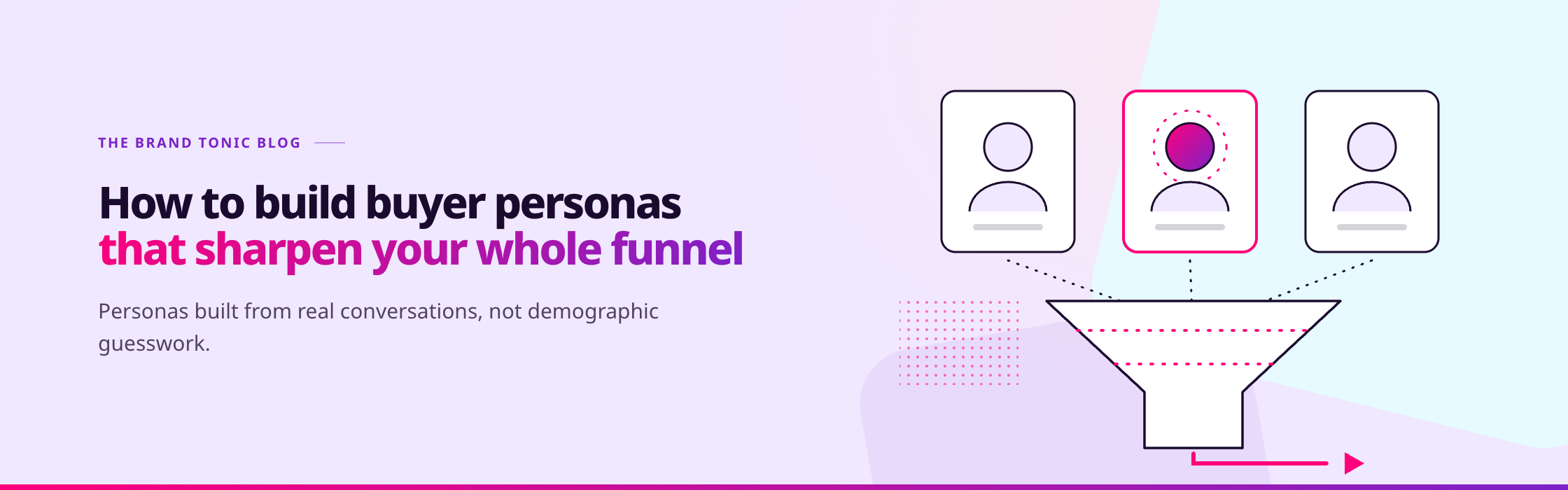
Ask five people on your team to describe your ideal customer and you’ll probably get five different answers. That’s the real cost of not having a buyer persona: not that your marketing looks unprofessional, but that marketing, content, and sales are all quietly targeting slightly different people, and none of them realize it until a deal falls apart in a way nobody saw coming.
A buyer persona isn’t a poster with a stock photo and a fake name pinned to the wall. Done right, it’s a decision tool: a shared, specific, data-backed picture of who you’re selling to, that shapes what you write, how sales talks about your product, and which leads are worth chasing. This post covers how to build personas from real data instead of guesses, how they differ from an ideal customer profile, and what a usable persona actually looks like.
The short answer
A buyer persona is a research-based profile of a specific type of buyer, built from real customer data (interviews, CRM patterns, and sales call notes) rather than assumptions, that describes their role, priorities, objections, and how they make decisions. Unlike an ideal customer profile, which defines the type of company you sell to, a buyer persona defines the individual people involved in that company’s buying decision. Strong personas align marketing, content, and sales around the same specific buyer, instead of each function working from a different mental picture.
Why most buyer personas don’t actually get used
Walk into most companies and you’ll find a persona document sitting in a shared drive that nobody has opened in a year. That’s usually because it was built from a brainstorm, not from data: a marketing team guessed at pain points, invented a name and a stock photo, and called it done.
Gartner’s research into B2B buying groups has found that a typical B2B purchase now involves multiple stakeholders, each weighing different priorities and often disagreeing with each other during the process. A single vague persona can’t capture that complexity. A persona built from real conversations with real buyers can.
Buyer persona vs. ideal customer profile: what’s the difference?
These two get confused constantly, and mixing them up is part of why personas end up useless.
- Ideal customer profile (ICP): describes the company. Industry, size, revenue range, growth stage, tech stack, and other firmographic traits that make a company a good fit for what you sell.
- Buyer persona: describes the person. Their role, what they’re measured on, what keeps them up at night, how they research and evaluate options, and what would make them say no.
You need both, and they work together. Your ICP tells you which companies to target. Your personas tell you how to actually talk to the humans inside those companies once you’re targeting them. A marketing strategy built on ICP alone still misses the mark, because it’s the individual buyer who reads your content, takes your sales call, and makes the case internally to buy.
How to build a buyer persona from real data, step by step
- Pull your best-fit customers from the last 12 to 18 months. Not your biggest customers, your best-fit ones: the ones who bought quickly, got value fast, and stuck around.
- Interview 5 to 8 of them directly. Ask about their role, what triggered the search for a solution, what almost stopped them, how they evaluated options, and what ultimately convinced them.
- Mine your CRM and sales call notes for patterns. Look for recurring objections, recurring language, and recurring reasons deals stalled or accelerated.
- Talk to your sales team. They hear the unfiltered version of buyer hesitation every single week. That’s data most personas skip entirely.
- Document the pattern, not just one person. A persona represents a repeatable type of buyer, built from common threads across several real people, not a biography of a single customer.
- Include what disqualifies a buyer, not just what qualifies one. Knowing who this persona is not for is just as useful as knowing who it is for.
- Review and update it every 6 to 12 months. Buyers change as your product, market, and pricing change. A persona built two years ago may no longer match who’s actually buying.
What does a usable buyer persona actually include?
Skip the fake name and stock photo. Focus on what’s actually useful to marketing, content, and sales:
- Role and reporting structure. What are they responsible for, and who do they answer to.
- What they’re measured on. This tells you what outcomes actually matter to them.
- Trigger event. What typically causes them to start looking for a solution like yours.
- Primary objections. The real reasons deals stall, pulled from actual sales conversations.
- Where they research. Which channels, publications, or peer sources they trust before talking to a salesperson.
- What convinces them. Case studies, ROI data, peer references, or a specific kind of proof.
What this looks like in practice: A 50-person SaaS company selling to mid-market operations teams builds two personas after realizing their content was written for IT buyers, but their actual champion was almost always an operations director. Through interviews, they learn this persona is measured on process efficiency, not technical specs, gets burned by vendors who overpromise implementation timelines, and trusts peer case studies more than product demos. Content shifts to lead with operational outcomes instead of feature lists, sales reframes early calls around implementation timelines instead of technical capability, and pipeline conversion improves within two quarters, because every part of the funnel is finally speaking to the same person.
How do buyer personas connect to content and sales enablement?
A persona is only valuable if it actually shapes decisions downstream. Once you’ve built one:
- Use it to prioritize topics in your content marketing strategy, so you’re writing for the person who actually reads and shares your content.
- Brief your sales team on persona-specific objections so they’re not improvising answers to the same questions every call.
- Build persona-specific case studies and sales assets, so reps always have a relevant story to send.
This is exactly where sales enablement strategy and marketing strategy have to work together. A persona built in isolation by marketing, without sales input, will always be incomplete. If you need outside help getting marketing and sales aligned on who you’re actually selling to, that’s a core piece of marketing strategy consulting.
Frequently asked questions
What is a buyer persona in B2B marketing? A buyer persona is a research-based profile of a specific type of individual buyer, including their role, priorities, and decision-making behavior, used to guide marketing, content, and sales strategy.
How many buyer personas should a company have? Most B2B companies need 2 to 4 well-developed personas, representing the key roles typically involved in a purchase decision. More than that tends to dilute focus rather than sharpen it.
What’s the difference between a buyer persona and an ideal customer profile? An ideal customer profile describes the type of company that’s a good fit for your product. A buyer persona describes the individual people within that company who are involved in the buying decision.
How do you validate a buyer persona? Test it against real sales calls and closed-won deals. If the persona’s stated priorities and objections match what your sales team actually hears, it’s validated. If not, revisit the underlying research.
How often should buyer personas be updated? Review personas every 6 to 12 months, or sooner if your product, pricing, or target market shifts meaningfully, since outdated personas can misdirect content and sales messaging.
The bottom line
A buyer persona built on guesses is worse than no persona at all, because it gives a false sense of alignment while marketing, content, and sales quietly aim at different targets. Build yours from real interviews, real CRM data, and real sales conversations, and it becomes a decision tool your whole team actually uses. If your funnel feels unfocused because nobody agrees on who you’re really selling to, that’s a strategy problem we solve. Book a call to talk through building personas that actually sharpen your funnel.