Marketing Plan vs. Marketing Strategy: What Actually Comes First
September 17, 2026
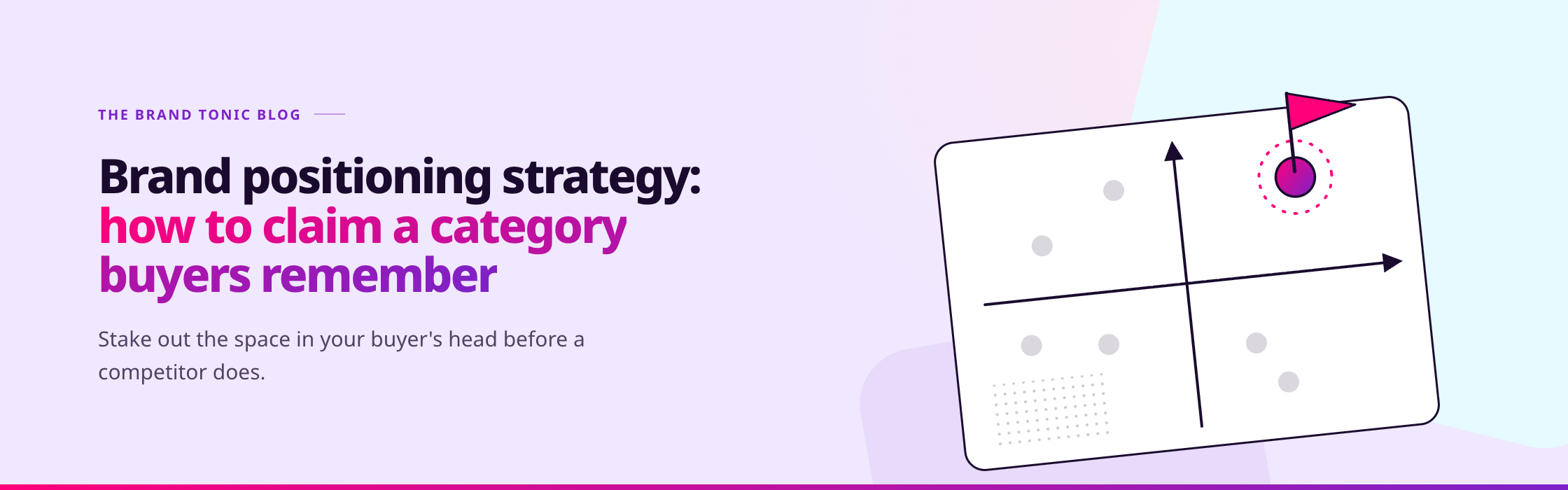
Ask five people at your company to describe what makes you different from your closest competitor, and you’ll usually get five different answers. That’s not a branding problem you fix with a new logo. It’s a brand positioning strategy problem, and it’s the single most expensive gap on this list, because everything downstream, your website copy, your sales pitch, your ad targeting, your content, inherits whatever confusion lives at the positioning layer. Get positioning right and every other marketing decision gets easier. Get it wrong and you’re funding a lot of activity that never quite lands. This post walks through why positioning is the foundation everything else sits on, a framework for building it, a usable positioning statement template, and what it looks like when a company gets it right.
The short answer
Brand positioning strategy is the deliberate decision about which category you compete in, which specific buyer you’re built for, and why you’re the better choice for that buyer over the alternatives they’d otherwise consider. It’s not a tagline or a mission statement. It’s the underlying logic that your marketing, sales, and product messaging all need to agree on. Strong positioning is specific enough that a buyer can repeat it back to a colleague accurately.
Why is positioning the foundation of everything else in marketing?
Because every other marketing decision is downstream of it. Your website headline, your ad copy, your sales deck, your content topics, even your pricing page, all of them are attempts to communicate your positioning to a specific audience. If the positioning underneath is vague or contested internally, every one of those assets ends up slightly inconsistent, and buyers notice, even if they can’t articulate why something feels off.
Positioning strategist April Dunford, whose framework has become a standard reference for B2B companies, argues that most positioning problems aren’t creative problems, they’re clarity problems: companies haven’t actually decided which market they’re competing in and for whom, so their messaging tries to be everything to everyone and lands as nothing to anyone.
How do you build a brand positioning strategy?
Use this five-step framework:
- Identify your true competitive alternatives. This isn’t just direct competitors. It includes the status quo, spreadsheets, manual processes, doing nothing, anything a buyer might choose instead of you.
- Define your unique attributes. What do you have that the alternatives genuinely don’t? Be specific and honest. Vague claims like “better service” don’t hold up.
- Translate attributes into value. For each unique attribute, articulate the concrete outcome it creates for the buyer. Features are not value. Outcomes are.
- Identify who cares most. Not everyone values the same outcome equally. Find the segment for whom your specific value is most urgent, and target your positioning at them first.
- Choose your category. Decide how you want buyers to mentally file you. Sometimes that’s an existing category you can win a piece of. Sometimes it’s worth framing a narrower, more winnable category around your specific strength.
What does a usable positioning statement look like?
A simple, reliable template:
For [specific target buyer] who [has this specific problem or need], [company name] is the [category] that [key differentiator or unique value], unlike [primary alternative], we [specific proof point or reason to believe].
This isn’t meant to be customer-facing copy. It’s an internal reference document that keeps every team, marketing, sales, product, aligned on the same claim, so the website, the sales pitch, and the ad copy all say a consistent version of the same thing in their own voice.
What this looks like in practice
A 35-person professional services firm came to us describing themselves as “a full-service consulting firm that helps businesses grow.” That’s not positioning, it’s a category with no differentiation, and it made every piece of their marketing generic by default. Their website tried to speak to five different buyer types at once. Their sales team pitched differently depending on who was in the room, because there was no shared internal answer to “why us.”
Working through the framework, it became clear their real competitive advantage wasn’t breadth, it was depth in a specific niche: operational turnarounds for mid-market healthcare practices, a segment where they had unusually strong outcomes and case studies nobody else in their category could match. Repositioning around that specific claim, rather than the generic “full-service” framing, meant saying no to some prospects outside that niche. It also meant their website, sales deck, and content could all point in the same direction for the first time. Inbound inquiries dropped in volume but rose sharply in quality, because the messaging was now specific enough to self-select the right buyers before a sales call ever happened.
That specificity is also what makes every piece of content marketing strategy work harder, because content built on clear positioning has an actual point of view instead of generic advice that could have come from any competitor.
How do you know if your current positioning is actually working?
Check for these signals:
- Buyers can repeat your value proposition back to you, roughly accurately, after one conversation. If not, it’s not landing.
- Your sales team pitches consistently, without needing to improvise a new angle each time. Inconsistent pitching is a sign the underlying positioning was never clearly defined.
- Your marketing content has an actual point of view, not generic industry advice. Weak positioning tends to produce interchangeable content.
- You can name who you’re deliberately not targeting. Positioning that tries to appeal to everyone usually resonates with no one.
How does positioning connect to the rest of the marketing engine?
Positioning isn’t a one-time branding exercise you do and file away. It’s the reference point every other strategic decision gets checked against. When you’re deciding which content topics to prioritize, which channels to invest in, or how to frame a sales deck, the question is always the same: does this reinforce our positioning, or does it dilute it? Companies without a clearly defined positioning strategy tend to make these decisions inconsistently, project by project, which is exactly why their marketing feels disjointed even when individual pieces are well executed. This is core to how a fractional CMO builds a marketing engine: positioning first, because everything else is built on top of it.
Frequently asked questions
What’s the difference between brand positioning and a tagline? A tagline is a piece of external copy. Positioning is the internal strategic decision about your category, audience, and differentiation that the tagline (and everything else) is supposed to communicate. You can change a tagline in an afternoon. Positioning takes real strategic work.
How often should you revisit your positioning strategy? Revisit it when your market shifts meaningfully, when you enter a new segment, or roughly annually as a check-in. Frequent, reactive repositioning usually signals the original work wasn’t done thoroughly.
Can a small company have strong positioning without a big brand budget? Yes. Positioning is a strategic exercise, not a design project. It costs focused thinking time, not a large budget, though it does require someone experienced enough to make and defend the tradeoffs involved.
Does positioning matter more for B2B or B2C companies? It matters for both, but B2B buyers in particular tend to evaluate multiple vendors methodically, which makes clear differentiation a bigger factor in whether you make the shortlist at all.
What’s the biggest mistake companies make with positioning? Trying to appeal to everyone. Broad positioning feels safer, but it produces messaging so generic that no specific buyer feels like it was written for them.
The bottom line
Brand positioning strategy is not a branding nicety. It’s the foundation every other marketing decision is built on, and getting it wrong quietly taxes every campaign, every piece of content, and every sales conversation that comes after it. If your team can’t articulate your positioning in one clear sentence buyers would repeat back accurately, that’s the highest-leverage place to start. Book a call to build a positioning strategy that actually holds up under pressure.