Marketing Strategy vs. Marketing Tactics: Why the Difference Costs You
September 15, 2026
Brand Positioning Strategy: How to Claim a Category Buyers Remember
September 22, 2026
Somebody hands you a marketing plan. It has a content calendar, a list of campaigns, a quarterly budget. It looks thorough. It might even look impressive in a slide deck. But if nobody built a strategy underneath it, that plan is a schedule for activities with no shared reason to exist. This is one of the most common gaps we see at growing companies: a marketing plan vs marketing strategy confusion where teams build the calendar before they’ve made the actual decisions the calendar should be based on. This post untangles the two, shows you the right build order, and walks through what happens when a plan gets built on no strategy at all.
The short answer
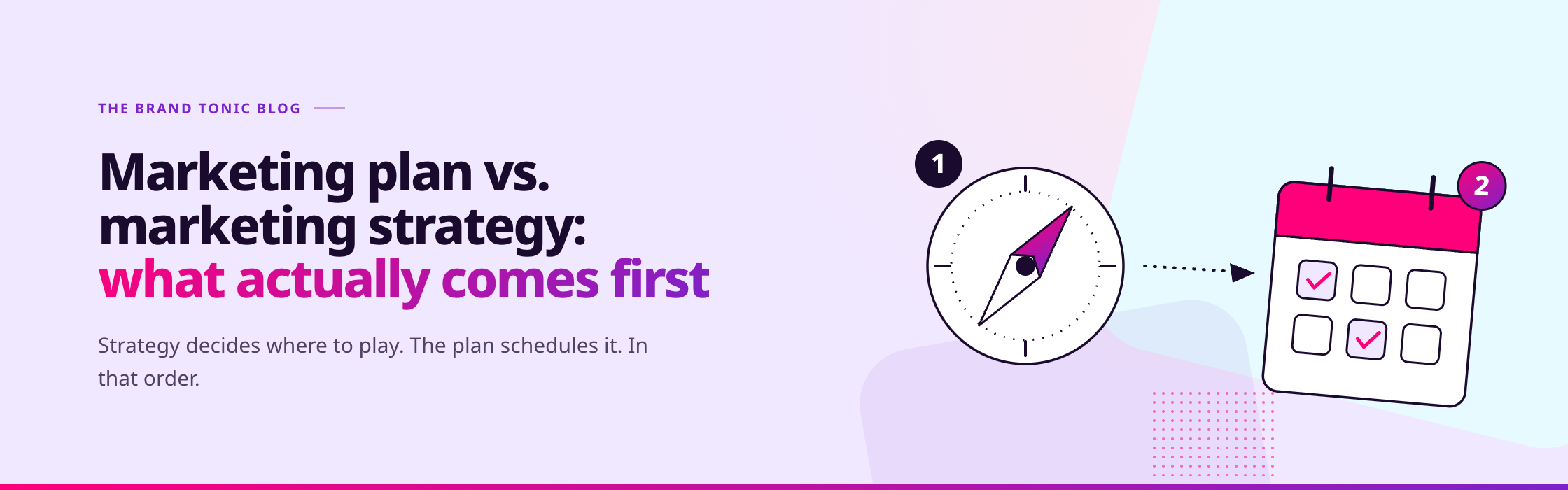
Marketing strategy defines the why and where: who you’re targeting, what makes you the right choice, and which markets or channels you’ll prioritize. A marketing plan defines the how and when: the specific campaigns, content, budget, and timeline that execute the strategy. Strategy always comes first. A plan built without a strategy underneath it is a list of dates with no logic connecting them.
What is the difference between a marketing plan and a marketing strategy?
Marketing strategy is a set of decisions. Marketing plan is a schedule of actions. Neither one replaces the other, but they answer fundamentally different questions.
Strategy answers:
- Who is our target customer, specifically
- What problem do we solve that alternatives don’t
- Which markets, segments, or channels will we prioritize
- How will we know if it’s working
Plan answers:
- What campaigns are we running this quarter
- What’s the content calendar
- What’s the budget allocation by channel
- Who owns what, and by when
You can think of strategy as the destination and the route, and the plan as the turn-by-turn directions and the fuel stops. Without the route already chosen, the turn-by-turn directions don’t mean anything.
Why does the sequence matter?
Because a plan is only as good as the decisions it’s built on. If you skip straight to planning, is your quarterly content calendar built to reach a specific, well-defined buyer, or is it built to fill a publishing cadence? Most teams that skip strategy end up with plans that are internally consistent (dates, owners, deliverables all line up) but strategically hollow. They execute well against nothing in particular.
According to HubSpot Research, companies with a documented marketing strategy are significantly more likely to report their marketing efforts as effective compared to those working from an ad hoc plan with no strategic foundation. Documentation isn’t the magic ingredient. It’s a proxy for having actually made the underlying decisions before building the calendar around them.
How do you know if your “strategy” is really just a plan wearing a strategy costume?
Ask these questions about your current marketing documentation:
- Does it name a specific target segment, or does it say “our customers”? Vague targeting is a sign the strategic work hasn’t happened.
- Does it explain why this quarter’s priorities matter more than alternatives you didn’t choose? A real strategy involves saying no to things. A plan usually just lists what you said yes to.
- Would the plan change if the market shifted, or only if the calendar got full? Strategy should flex with market reality. A plan built without one usually just gets rescheduled, not rethought.
If your “strategy doc” is really just a content calendar with a mission statement stapled to the front, you have a plan, not a strategy.
What this looks like in practice
A 60-person healthtech company came to us with a detailed, color-coded marketing plan. Blog posts scheduled, email sends mapped, a paid campaign budgeted out through the next two quarters. On paper, it looked like a mature marketing operation.
The problem surfaced fast: nobody could articulate why the company’s target customer should choose them over three well-funded competitors doing almost identical messaging. The plan had never been built on a strategic decision about positioning or segment focus. Every campaign was competent execution in service of nothing distinctive. Leads came in, but they were unqualified at a high rate, and sales kept asking marketing why the messaging didn’t match what buyers actually cared about.
The fix wasn’t scrapping the plan and starting from zero on execution. It was pausing new campaigns for a few weeks to answer the strategic questions first: which specific buyer segment converted best historically, what genuine differentiation existed beyond feature comparisons, and which one or two channels that segment actually used. Once that strategic layer existed, the plan got rebuilt around it, not replaced, just re-anchored. The same team, the same budget, a completely different trajectory in qualified pipeline within two quarters.
This is the same build order we use inside the 5-part marketing engine: strategy defines the direction, and the plan becomes the execution layer that makes it real on a calendar.
What happens when you build a plan with no strategy underneath it?
- Campaigns compete with each other instead of compounding. Without a shared strategic thread, one campaign can undercut or contradict another.
- Budget gets allocated by opinion, not by strategic priority. Whoever argues loudest in the planning meeting gets the bigger line item.
- You can’t diagnose underperformance. When a campaign misses its numbers, there’s no strategic reference point to check it against, so the fix defaults to “try something else next quarter.”
- Sales and marketing drift apart. Sales starts describing a different customer and different value proposition than what marketing is promoting, because there was never a shared strategic definition of either.
This is exactly the gap a fractional CMO is built to close: owning the strategic decisions so the plan that follows actually has something real to execute against.
Frequently asked questions
Do I need a marketing strategy before I build a marketing plan? Yes. A plan built without a strategy underneath it is a schedule of activities with no shared logic connecting them, which makes it much harder to know what’s working and why.
How long should a marketing strategy last before revisiting it? Most growing companies revisit core strategic decisions, like target segment and positioning, every 6 to 12 months, while the plan built around it gets refreshed quarterly.
Can a small company skip formal strategy and just plan as they go? You can, but it usually costs more in wasted spend than it saves in time. Even a lightweight strategic framework, defined in a few hours with the right facilitation, pays for itself by making planning faster and more focused.
What’s the fastest way to tell if my current plan lacks a strategy? If you can’t explain in one sentence why your target customer should choose you over the alternative, and why your current priorities matter more than the ones you didn’t pick, the strategic layer is missing.
Who should own marketing strategy at a company without a marketing department? Usually a fractional CMO or senior marketing leader, someone with the experience to make and defend strategic tradeoffs, distinct from whoever is executing the plan day to day.
The bottom line
Marketing plan vs marketing strategy isn’t a matter of one being more important. It’s a matter of sequence. Strategy has to come first, because it’s the thing that makes the plan worth executing. If your team has a detailed calendar but can’t explain the strategic decisions underneath it, that’s the gap to close before you add another campaign to the list. Talk to us about building the strategy your plan has been missing.